

The success of COP26 has been hotly debated, but at Industry Tracker we noticed only a few explicit announcements on industrial decarbonisation, despite these sectors accounting for around 24% of global emissions[1]. The two key announcements from COP26 specifically targeting industrial sectors were: the Glasgow Breakthrough Agenda, announced by the UK COP presidency and; The First Movers Coalition, a public private partnership between the US State Department and the World Economic Forum. In this blog we give our take on the Glasgow Breakthrough Agenda which through public-private partnerships could provide a catalyst for deployment of the near zero emissions technologies essential to industrial decarbonisation.
Defining the Glasgow Breakthroughs Agenda
The Glasgow Breakthroughs Agenda was launched on November 2nd 2021, by the UK COP Presidency and the UNFCCC’s Race to Zero initiative, with 40 world leaders having signed up. This includes China, the US, India and the EU, representing more than 70% of the world’s economy[2]. It focuses on increasing the coordination, development and deployment of low-carbon technologies in five sectors, representing over 50% of global greenhouse gas emissions2 by 2030: power, road transport, steel, hydrogen and agriculture.
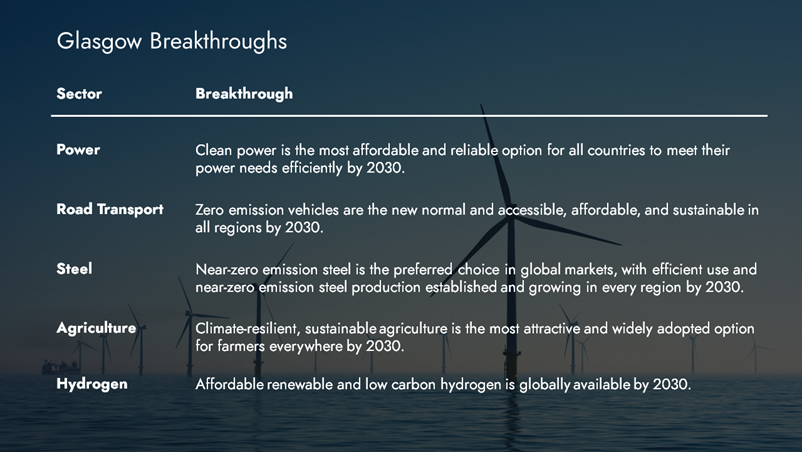
The Agenda aims to increase the affordability and accessibility of low-carbon technologies in these sectors. To achieve this, governments are expected to stimulate green investment at scale, align policies and standards, coordinate R&D and public investments, and unlock private finance. The UK government claims the initiative could create 20 million new jobs and generate $16 trillion globally2.
Big ambitions, lacking in detail
The announcement currently provides little detail on implementation but does outline an annual ‘Global Checkpoint Process’ which aims to maintain cooperation. This will see leaders discussing sectoral progress every year from 2022, alongside annual reports from the International Energy Agency, the International Renewable Energy Agency and UN High Level Champions. However, more clarity on implementation is required for countries and companies to make meaningful progress.
Real opportunities to increase public and private funding for industrial decarbonisation
Companies in industrial sectors like steel often lack the capital required to invest in the development of low-carbon technologies. However, in Europe in particular, public finance is already providing critical support for scaling near-zero emissions steelmaking through specific funding packages and policies. Our report Steeling for Net Zero, which analysed 10 of Europe’s top steelmakers, found that public funding on average contributed to 44% of total project budgets[1]. This is directly enabling companies to transition from traditional coal fed Blast Furnace – Basic Oxygen Furnace (BF-BOF) steel production to Hydrogen Direct Reduction – Electric Arc Furnace (HDR-EAF) production, with the potential to reduce CO2 emissions by 98%.
Public funding is not only key to driving early-stage low carbon innovation but can also de-risk investment in these technologies, unlocking the private finance required to bring them to scale. The Breakthroughs Agenda could provide a real opportunity to drive low carbon policy and funding mechanisms and the European steel sector could be a blueprint for effective public-private collaboration.
While Europe and other more developed regions have funding specifically aimed at industrial decarbonisation, this is not the case in much of the world. Regions such as South Asia and sub-Sharan Africa often have lower levels of state support for decarbonisation, yet these areas are set to be a significant source of future carbon emissions. The Glasgow Breakthrough Agenda must therefore focus on stimulating government support in these regions if it is to successfully reduce industrial emissions globally.
Hydrogen and Low Carbon Steel Synergies
It is encouraging to see that the Breakthroughs Agenda supports renewable and low-carbon hydrogen which is essential to near-zero steel production. While the announcement does not make specific reference to this synergy, our research on Europe’s top steelmakers found that public financing is already supporting partnerships between steelmakers, energy and technology firms and other industrial sectors to develop low carbon hydrogen production and infrastructure.
Governments are also providing legislative, regulatory and policy support needed for these large-scale developments, demonstrating the kind of holistic public sector support that the Breakthroughs Agenda should promote. Importantly, steel is not the only sector that can be decarbonised through hydrogen, and it could act as a catalyst to accelerate the development of the hydrogen economy more broadly.
In summary
The breakthrough agenda could provide real opportunities to stimulate the public sector funding and support needed to decarbonise industrial sectors. Valuable lessons can be learned from the European steel sector, where public sector support has been instrumental in leveraging private investment and driving the development of low carbon steelmaking. The Agenda should also encourage governments to recognise and support synergies in decarbonising sectors such as steel and hydrogen to maximise the impact of policy and funding packages. Increasing public sector support for industrial decarbonisation in emerging economies will be a real challenge for the Agenda, but ultimately could be key to reducing industrial emissions globally.
[1] IEA, 2021, Industry: Materials are the building blocks of society, https://www.iea.org/topics/industry
[2] UK Government, 2021, World leaders join UK’s Glasgow Breakthroughs to speed up affordable clean tech worldwide, https://www.gov.uk/government/news/world-leaders-join-uks-glasgow-breakthroughs-to-speed-up-affordable-clean-tech-worldwide
[3] Industry Tracker, 2021, Steeling for net zero: Are European steel companies ready for the climate transition?